By: Connor Schulz
Fort Bragg and Rural Life
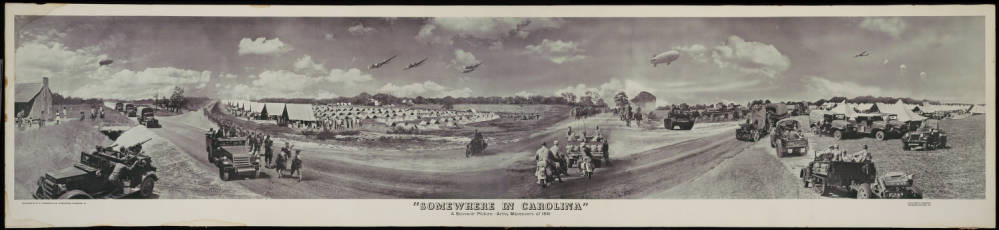
Fort Bragg is the largest military installation on earth, with an active duty personnel population of over 50,000. Fort Bragg was established in 1917, at the close of World War One. The installation has long been a foundational employer of the Fayetteville region, and much of the modern culture in the area has evolved in conjunction with Fort Bragg. Oral history interviews with nearby residents offer perspectives on impact of Fort Bragg in their communities, including the arrival of electricity.
In a Southern Oral History Program interview from 1984 with Lumbee interviewee John M. Gillis, he describes the effects of rural electrification on daily life in Robeson county. Specifically, Gillis notes that before the establishment of Fort Bragg, the Fayetteville area was sparsely populated. [1] The military influx created a surge in population growth, and along with that came industrialization; more specifically, rural electrification. According the Gillis, electricity reached the region in 1935. He describes this as a direct result of the establishment of Fort Bragg in 1917, and the population influx after World War I. [2] Gillis notes communal resistance to rural electrification; people claimed that electricity was yet another way for the government to exert socialistic powers. Areas closer to Fort Bragg received electricity first. Gillis also discusses the expansion of the Fayetteville city limits. Before Fort Bragg he lived 13 miles from the Fayetteville limit, and at the time of the interview that number had dropped to 6 miles.
Gillis remembers a farmer who states: “The greatest thing in the world is to have God in your heart, and the next greatest thing is to have electricity.” [3]
In a more recent Southern Oral History Program interview, from 2018, Fayetteville resident Lori Hinga describes her experience living near Fort Bragg. [4] She describes eastern NC as “even more rural” than where she grew up in North Michigan. Hinga talks about feeling lonely and isolated by the sparsity of the region. [5] The Fayetteville metro area has a population of 209,000 people, spreading across a large swath of Eastern NC. [6] Therefore, with such a large population, it seems counterintuitive that it would feel desolate. However, according to some estimates, almost half of those people are associated with Fort Bragg, either as a soldier, family member, or employee. [7] With such a substantial population connected to the base, it is safe to say that Fort Bragg has immense influence over the surrounding region.
[1]. Fayetteville, North Carolina Population 2019. (n.d.). Retrieved from http://worldpopulationreview.com/us-cities/fayetteville-population/.
[2]. Interview with John Gillis by Hudson Lane, 1984, D-0018, in the Southern Oral History Program Collection #4007, Southern Historical Collection, Wilson Library, University of North Carolina at Chapel Hill
[3]. Interview with John Gillis by Hudson Lane, 1984, D-0018, in the Southern Oral History Program Collection #4007, Southern Historical Collection, Wilson Library, University of North Carolina at Chapel Hill
[4]. Interview with Lori Hinga, 26 June 2018, Y-0032, in the Southern Oral History Program Collection #4007, Southern Historical Collection, Wilson Library, University of North Carolina at Chapel Hill.
[5]. Interview with Lori Hinga, 26 June 2018, Y-0032, in the Southern Oral History Program Collection #4007, Southern Historical Collection, Wilson Library, University of North Carolina at Chapel Hill.
[6]. US Census Bureau. “Census.gov.” Census.gov, https://www.census.gov/.
[7]. Powers, Rod. “Learn About Living in Fort Bragg, North Carolina.” The Balance Careers, The Balance Careers, 11 Oct. 2019, https://www.thebalancecareers.com/fort-bragg-north-carolina-3344653.
[8]. “Somewhere in North Carolina,” in the North Carolina County Photographic Collection #P0001, North Carolina Collection Photographic Archives, The Wilson Library, University of North Carolina at Chapel Hill.
 Fayetteville Case Studies