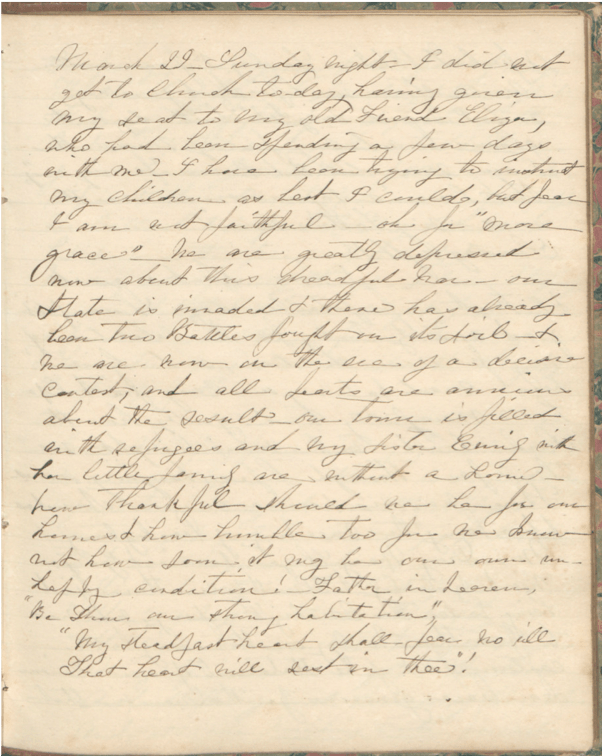
Transcript of entry:
March 29 – Sunday night – I did not get to Church today, having given my seat to my old Friend Eliza, who had been spending a few days with me – I have been trying to instruct my children as best I could, but fear I am not faithful – oh for “more grace” – we are greatly depressed now about this dreadful war – our state is invaded & there has already been two Battles fought in its soil – & we are now on the sea of a decisive contest, and all hearts are anxious about the result – our time is filled with refugees and my Sister Emily with her little family are without a home – here Thankful should we be for our homes & how humble too for we know not how soon, it may be our own unhappy condition! – Father in heaven, “Be Thou our strong habitation,”
“My steadfast heart shall fear no ill
That heart will rest in thee!”
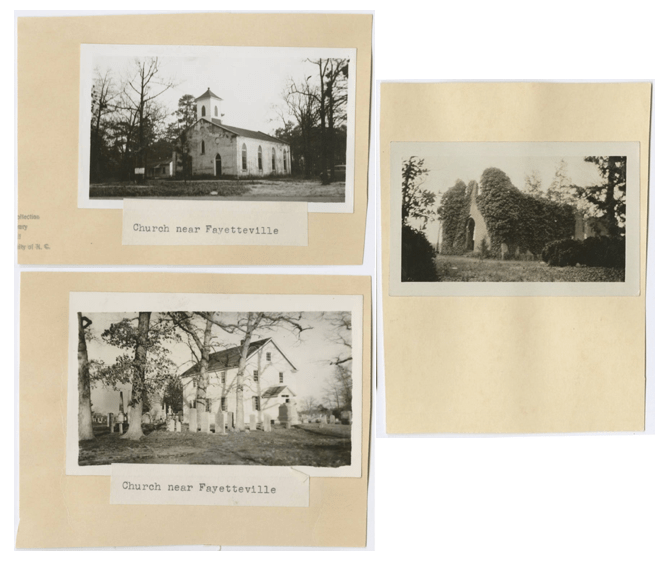
Jane Evans Elliot was a diarist during the Civil War, who was primarily active in Fayetteville, North Carolina. She lived on the Ellerslie Plantation with her husband, Alexander Elliot, whom with she had seven children [3]. Her husband was involved in many different facets of the society, including serving in the North Carolina House of Commons from 1824-1825, the North Carolina Senate in 1826, and becoming a colonel during the Civil War [4]. Alexander was busy and left Jane to take care of the house and raise the children, so she consequently began to keep an avid account of her daily life. In total, she wrote three diaries that encapsulate her life in Fayetteville from age 17 to 62.
Elliot’s diary entries include her personal thoughts on her daily life, but they now give a great deal of context and insight into the historical events that she witnessed. Overall, the central themes in Elliot’s diaries are her reflections on church, religion, and family matters as well as addressing the Presbyterian New School Controversy of 1837-1838 and the Civil War.
The diary entry from March 29, 1862 was near the start of the Civil War and shortly after the time that battles began to take place in North Carolina. In the entry, she describes missing church because she gave her seat to an old friend who was visiting. Given this admission, we might assume church was a frequent and important factor in Elliot’s life. Next she transitions into talking about how she has tried to prepare her children for the war but is worried about the horrifying terror to come. She even goes far enough to express her and her societies depression that has come from the war after North Carolina has been invaded. She writes that two battles have already been fought on NC soil, which were most likely the Battle of Roanoke Island and the Battle of New Bern, two vicious battles won by the Union. Elliot writes about the fear that the North Carolinians have because they “are now on the sea of a decisive contest, and all hearts are anxious about the result.” [5]
Near the end of her entry, Elliot writes about how many people have become refugees, including her sister and her kids. She makes a comment about how they need to be thankful and humble for their homes because they could become refugees if the war progresses more. Elliot ends her entry with a religious quote implying that God is their safe haven and she will not doubt or worry because her heart will be resting with him.
The diaries of Jane Evans Elliot are important because they give first-hand accounts of what life was like during these times. Furthermore, the diaries are important to Fayetteville because they demonstrate the cultural and political experiences from the city in this time as well as depicting the life and role of women and girls coming to age during this time. Finally, Jane Evans Elliot significantly contributed to recording the literary history of Fayetteville.
By: Elliot Evans
[1] Scan 139 from Jane Evans Elliot Diaries #5343, Southern Historical Collection, The Wilson Library, University of North Carolina at Chapel Hill
[2] Cumberland County: Churches in the North Carolina County Photographic Collection #P0001, North Carolina Collection Photographic Archives, The Wilson Library, University of North Carolina at Chapel Hill.
[3] Survey and Planning Unit (April 1974). “Ellerslie” (pdf). National Register of Historic Places – Nomination and Inventory. North Carolina State Historic Preservation Office. Retrieved 11/05/2019.
[4] Survey and Planning Unit (April 1974). “Ellerslie” (pdf). National Register of Historic Places – Nomination and Inventory. North Carolina State Historic Preservation Office. Retrieved 11/05/2019.
[5] Scan 139 from Jane Evans Elliot Diaries #5343, Southern Historical Collection, The Wilson Library, University of North Carolina at Chapel Hill
 Fayetteville Case Studies