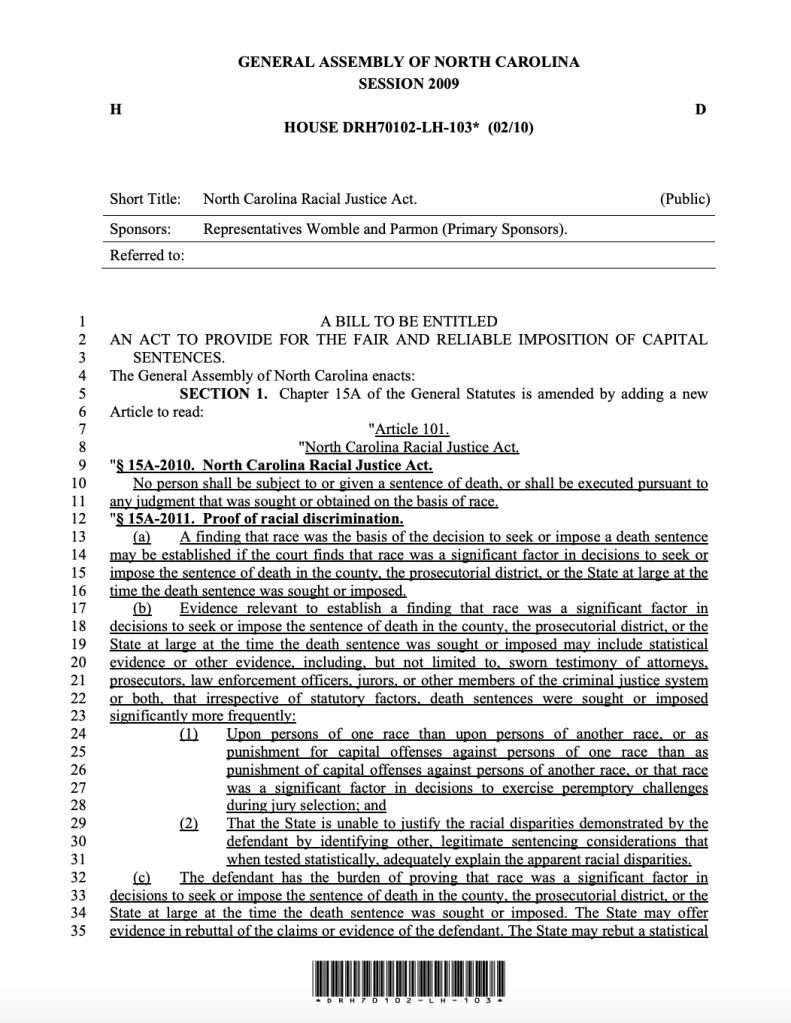
The Racial Justice Act (RJA) was proposed in 2009 in the North Carolina General Assembly. The only of its kind, it was “an act to provide for the fair and reliable imposition of capital sentences”1. In other words, it stated that no prisoner can be given the death sentence if they can prove that the judgement was brought about on the basis of race2.
The first death row inmate to use the Racial Justice Act was Marcus Reymond Robinson from Cumberland County in Fayetteville. In 1994, Robinson was convicted and found guilty of murder. In 2010, Robinson’s defense argued under the Racial Justice Act to relieve him of his death sentence. They were successful. Judge Gregory Weeks ruled that black jurors were unrightfully blocked from serving. Robinson’s sentence was commuted to life in prison without parole. Similarly, Judge Week’s ruled under the Racial Justice Act for three other Cumberland County death row inmates. Nearly all the inmates on death row attempted to have their sentences repealed under the act, including white inmates. It was a sign of hope for them3.
Intense controversy surrounded the act at all stages. When the four inmates were removed from death row, the act received the most backlash. This was just one of the problems facing it. Another problem was that the act was passed in a party-based fashion, meaning that the majority who were in favor were Democratic and the majority who were against were Republican. Conservatives were constantly trying remove the act4. North Carolina Democratic Senator Ellie Kinnaird was one of the legislators spearheading the act’s passing. In a series of emails, found in UNC archives, between Kinnaird and other legislators, they discuss a study, involving charges and sentences, to be launched in order to refine the RJA’s guidelines in subsequent hearings. However, due to the backlash it received, the District Attorney’s office and other case lawyers refused to hand over all their case files with any relation to the act5. Ultimately, the act was repealed in 2013.
In 2015, the four cases that Judge Weeks resentenced were reexamined by the North Carolina Supreme Court. The court ruled that Judge Weeks’ did not properly review under the Racial Justice Act. The four inmates from Cumberland County were placed back on death row. For Conservatives, this was a victory. For Democrats, this was a legislative retreat in their efforts to eliminate racism within the justice system6.
Although this act was not designed for Fayetteville, its impacts on the town make it important to the town’s legacy. Going back to the voting, both of the Cumberland County legislators voted in favor of the RJA7. Judge Weeks took the first steps in addressing potential racism in the town’s legal system by being the first to use the act. Even though it didn’t stick, the sentencing illuminated racial divides in the town: divides that remain today. Past and present in the American South, racism is a pressing issue. This act was a step towards eradicating that in our justice system, which today, continues to be a site for Black and brown injustice.
[1] Severson, K. (2013, June 5). North Carolina Repeals Law Allowing Racial Bias Claim in Death Penalty Challenges. The New York Times. Retrieved from www.nytimes.com/2013/06/06/us/racial-justice-act-repealed-in-north-carolina.html
[2] North Carolina Racial Justice Act, S. 461, 111th Cong. (2009).
[3] Woolverton, P. (2018, July 17). Cumberland death row inmates say their rights were violated. The Fayetteville Observer. Retrieved from https://www.fayobserver.com/news/20180717/cumberland-death-row-inmates-say-their-rights-were-violated
[4] Blythe, A. (2015, December 18). NC Supreme Court vacates Racial Justice Act decisions. The News & Observer. Retrieved from http://www.newsobserver.com/news/politics-government/state-politics/article50478335.html
[5] Emails Regarding Racial Justice Act Studies, in the Ellie Kinnaird Papers #5356, Southern Historical Collection, The Wilson Library, University of North Carolina at Chapel Hill.
[6] Woolverton, P. (2018, July 17). Cumberland death row inmates say their rights were violated. The Fayetteville Observer. Retrieved from https://www.fayobserver.com/news/20180717/cumberland-death-row-inmates-say-their-rights-were-violated
[7] Racial Justice Act Voting History, in the Ellie Kinnaird Papers #5356, Southern Historical Collection, The Wilson Library, University of North Carolina at Chapel Hill.
[8] The Winston Salem Chronicle (2012 April 26). http://newspapers.digitalnc.org/lccn/sn85042324/2012-04-26/ed-1/seq-5/
[9] North Carolina Racial Justice Act, S. 461, 111th Cong. (2009).
 Fayetteville Case Studies